
ReForce

Learning Force‑aware Retargeting for Dexterous Manipulation

Yuhang Wu, Lingqi Zeng, Changwei Jing, Geng Chen, Jianglong Ye†, Xiaolong Wang†

† Equal advising.

Explore the research
01 / Overview

From motion to contact

Human motion and force intent, adapted through robot tactile feedback.

One tracker
No digital twin
Live & learned
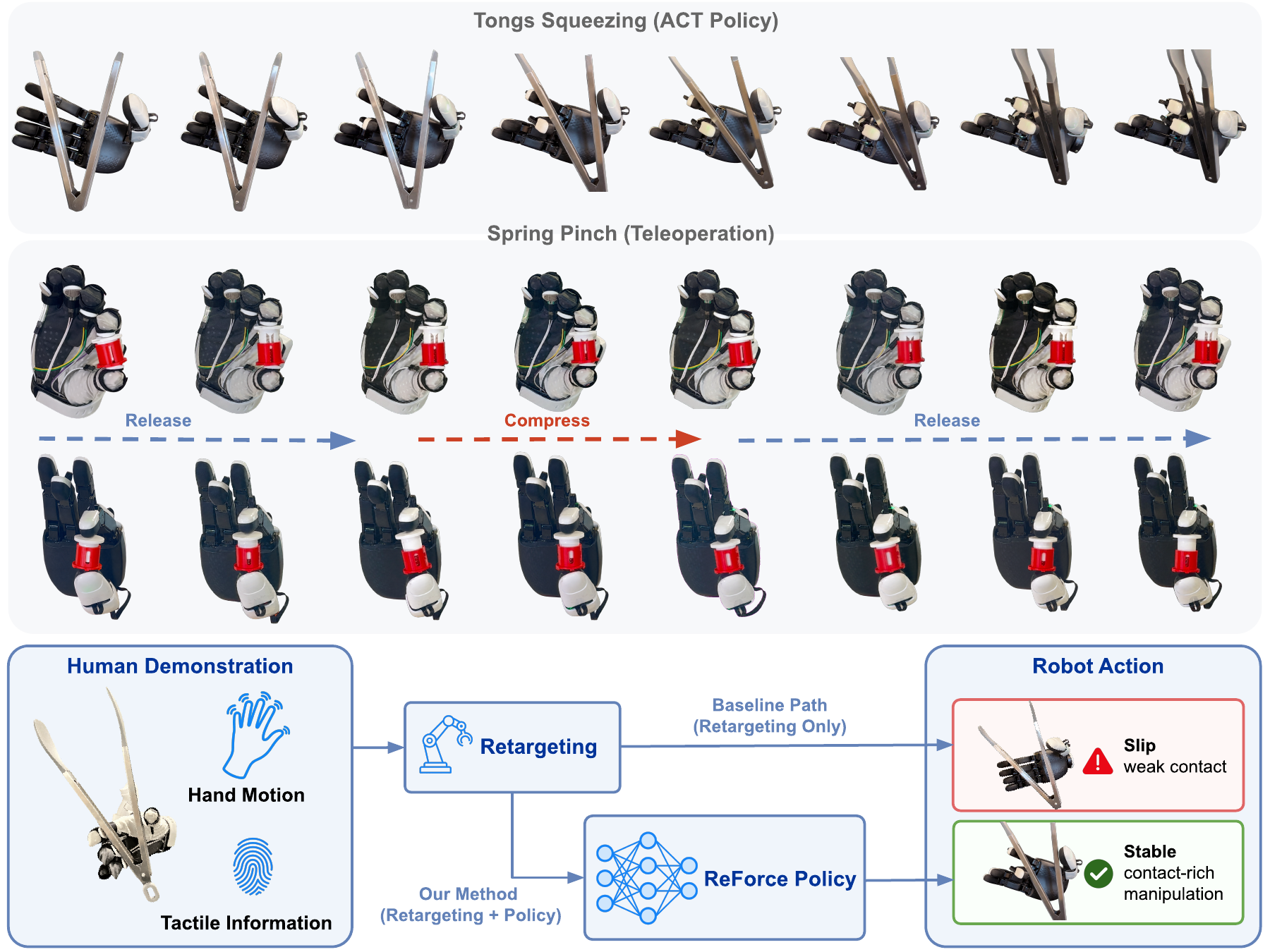
Tongs squeezing with ACT references, spring-pinch release and compression, and the ReForce retargeting pipeline.
Read the abstract

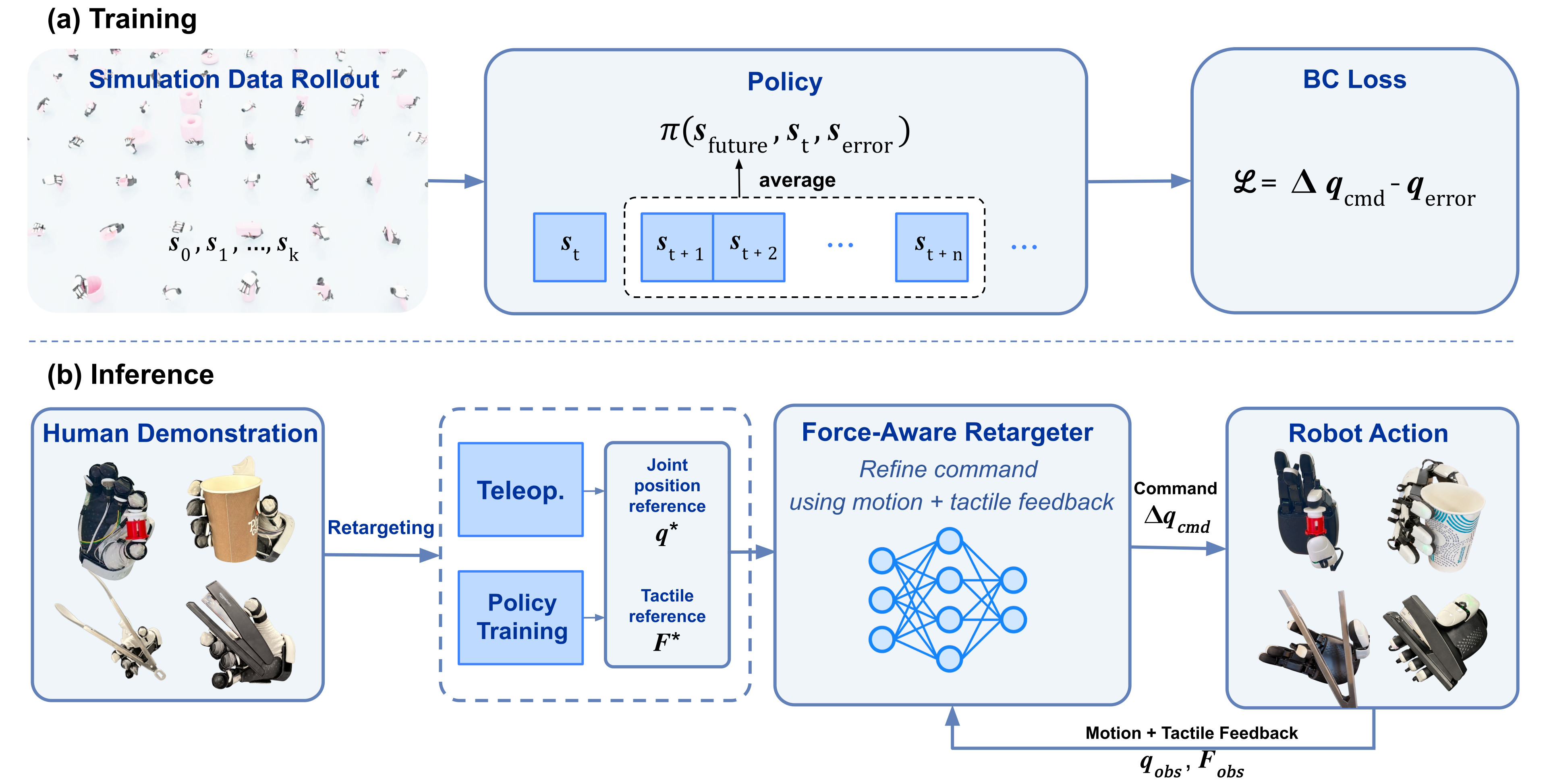
Human demonstrations offer a scalable data source for dexterous manipulation, but transferring them to robot actions remains challenging due to the embodiment gap. Today's retargeting is mostly kinematic, yet manipulation is decided by force, which governs how the hand interacts with the object and how the object moves. In this paper, we present ReForce, a Force-aware Retargeting method that turns human motion and forces into robot actions that reproduce the intended contact. ReForce predicts a residual on the kinematically retargeted action to reach the desired force, using a general force tracker trained on large-scale simulation interactions. It supports both online force-aware teleoperation and offline data translation. In simulation and on real hardware, ReForce achieves lower force-tracking error and stronger multi-finger contact engagement on contact-rich tasks such as paper-cup grasping and tongs manipulation.

02 / Method

Learn in simulation. Adapt on the robot.

A learned controller tracks motion and force targets with tactile feedback.

Training on future motion-and-contact targets from simulation, followed by deployment with human-derived references and robot tactile feedback.
MuJoCo rollouts · Dex1B objects and grasps

Training mixture

Recovery from stalled references and pose drift.

Ablation results

03 / Human-to-robot system

Human intent. Robot feedback.

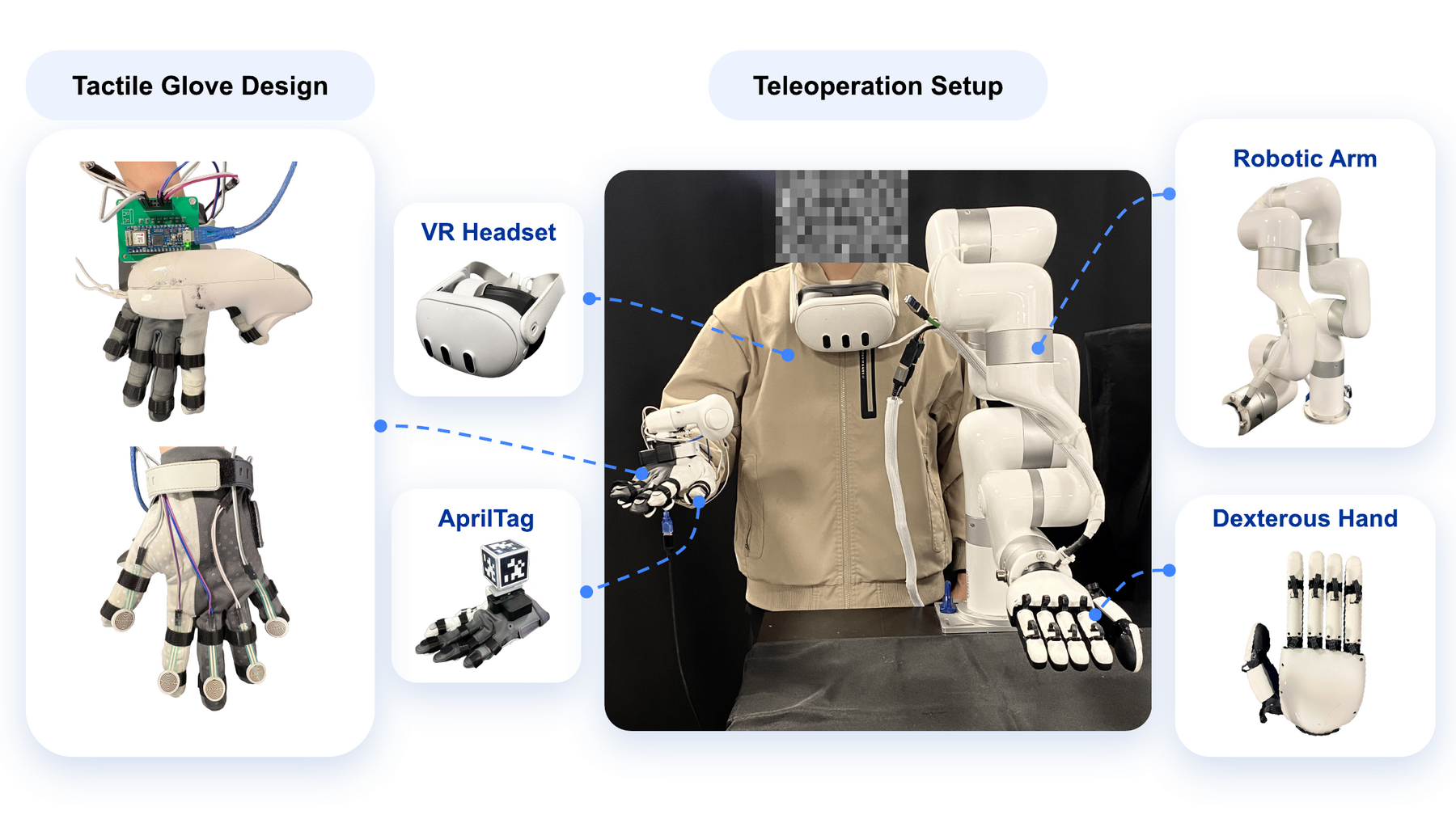
Human motion and forces guide an xArm and 12-DoF XHand.

Tactile Manus glove with fingertip FSR sensors, Quest wrist tracking, AprilTag demonstration tracking, xArm and XHand robot platform.
Live teleoperation
Quest · Manus · Fingertip FSRs
Demonstration collection
AprilTag + RealSense L515
Robot feedback
Joint states + fingertip forces (N)
04 / Experimental evaluation

Force tracking and task execution

↑ Higher / ↓ lower is better. Bold: best. Blue: ReForce.

Real-world execution

A / Recorded references

Paper-cup grasping

All methods follow the same recorded motion-and-force references.

Paper · Table I
Force-tracking error

Mean force error · 5 trials per grasp.

Real-world paper-cup grasping replay. Mean force-tracking error in Newtons; lower is better.
Grasp Replay
N ↓
Admittance
N ↓
ReForce
N ↓
Side 0.309 0.280 0.247
Top 0.736 0.619 0.474

ReForce achieves the lowest force-tracking error in both grasps.

B / Learned references

Execution with ACT references

Compare the reference policy alone, with admittance control, and with ReForce.

Tongs squeezing

Reference policy
+ Admittance
+ ReForce
Paper · Table IV
Task success & contact quality
Scroll for all metrics →
Real-world execution with learned references, grouped by task. Bold indicates the best result for each metric within each task.
Method Force-safe
success ↑
Tracking
error (N) ↓
Over-force ↓ Severe missing
contact ↓
Active
fingers ↑
Paper cup
Reference policy 30.0% 0.812 0/10 7/10 0.17
Reference policy + Admittance 60.0% 0.683 4/10 1/10 1.26
Reference policy + ReForce 70.0% 0.124 2/10 0/10 2.61
Tongs
Reference policy 50.0% 0.454 0/10 5/10 0.94
Reference policy + Admittance 90.0% 0.419 0/10 1/10 1.34
Reference policy + ReForce 54.5% 0.441 4/11 1/11 1.62

Mean absolute force error in N. Failures / trials; lower failure rate is better.

Cup: lowest force error with ReForce. Tongs: higher force-safe success with admittance.

Evaluation details

Force-safe success requires task completion, forces below the task-specific threshold (1.0 N for paper cup; 3.0 N for tongs), and no severe missing-contact failure. A severe missing-contact failure means that three or more fingers never establish contact during the trial.

One ReForce paper-cup trial with missing tactile data is excluded from force-based statistics. Tracking error is computed for each trajectory over time and fingertips, then averaged equally across trials.

Closed-loop grasping in simulation

ManiSkill grasping

Shared references across replay, direct/gated admittance, and ReForce.

31 retained scenes100 Hz control2-second final hold
Paper · Table II
Grasp success & motion fidelity
Scroll for all metrics →
ManiSkill grasping evaluation. Success rate: higher is better. Motion-tracking error in radians: lower is better.
Method Success rate ↑ Motion-tracking error
rad ↓
Replay 12.9% (4/31) 0.0041
Direct Admittance 0.0% (0/31) 0.1720
Reference-gated Admittance 38.7% (12/31) 0.0456
ReForce 45.2% (14/31) 0.0467

Success: lift > 5 cm, ≥ 2 contacts at ≥ 0.1 N after a 2 s hold. Motion: full-rollout joint MAE (rad).

ReForce achieves the highest grasp success with motion error close to gated admittance.

Training data & policy inputs

14,605 held-out episodes · 3 seeds.

Paper · Table III
Mean force-tracking error (N)
Scroll for all inputs →
Simulation ablation of training-data composition and policy inputs. Mean force-tracking error in Newtons over three seeds; lower is better.
Training distribution State +
force target
+ Pose
reference
+ Error
features
Base 0.0601 0.0400 0.0388
+ Reference-stall augmentation 0.0592 0.0401 0.0381
+ Pose-drift augmentation 0.0609 0.0396 0.0385
+ Both augmentations 0.0590 0.0396 0.0379

Mixtures: reference stall 80/20; pose drift 90/10; both 70/20/10. Input columns are cumulative.

Pose references provide the largest improvement; both augmentations achieve the lowest error.

05 / Applications

More demonstrations

Live teleoperation and ACT across contact-rich tasks.

Online force-aware teleoperation

Spring pinch

Finger release

ACT demonstrations

Board wiping

Cup pouring

BibTeX

@misc{wu2026reforcelearningforceawareretargeting,
  title={ReForce: Learning Force-aware Retargeting for Dexterous Manipulation},
  author={Yuhang Wu and Lingqi Zeng and Changwei Jing and Jianglong Ye and Xiaolong Wang},
  year={2026},
  eprint={2608.15560},
  archivePrefix={arXiv},
  primaryClass={cs.RO},
  url={https://arxiv.org/abs/2608.15560},
}